
Fruit Update - August 27, 2026
UNIVERSITY OF MINNESOTA EXTENSION - www.extension.umn.edu
Apples
-
Apple sales are starting at the farmers market in southern Minnesota
-
Variety highlight: First Kiss, and dealing with fruit drop
-
Article: How to Determine Apple Ripeness: Starch, Firmness, and Brix Testing
Grapes
-
Table grape harvesting tips
-
Variety highlights: Reliance and Mars
Help us grow the Fruit Update series!
What’s working? What do YOU want more of? This is our annual request for your support of the UMN Fruit Update series and other articles by taking our short evaluation to let us know what you’ve enjoyed and what you want to see more of in the future!
Take our quick survey:
UMN Fruit and Veg News Annual Eval
Our newsletter is only a success because of readers like you, and we greatly appreciate your feedback!
Apples
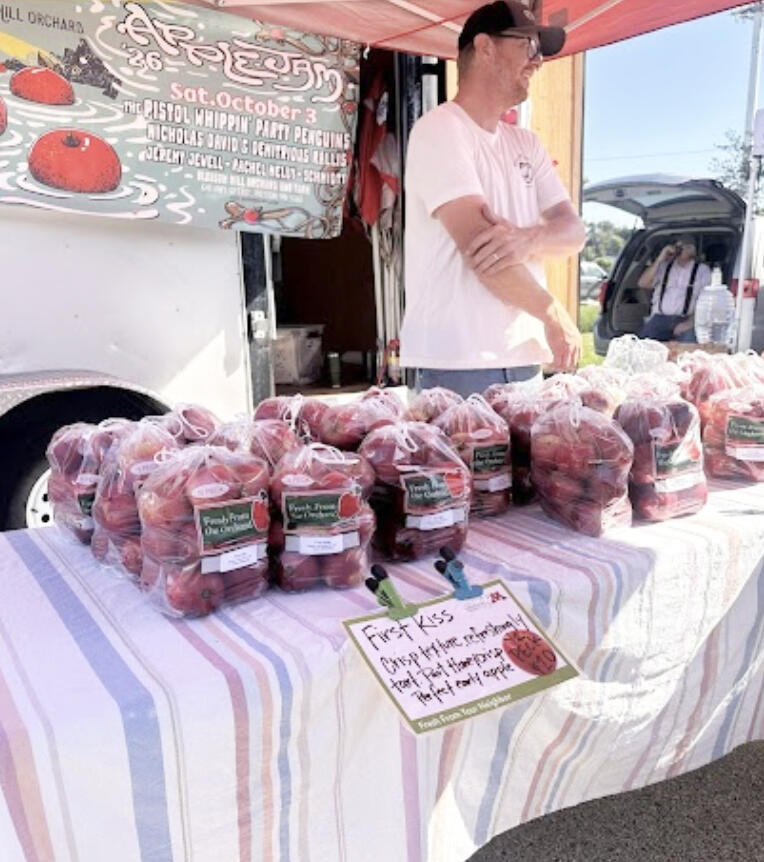
Apple sales are starting at the farmers market in southern Minnesota

Image: Blossom Hill Orchard sold First Kiss apples at the Rochester, Minnesota, farmers market on Saturday, August 22nd.
Many consumers have a mental image connecting local apple orchard visits and purchases with the fall, but some of the earliest ripening apple varieties are ready in mid-to-late August in southern Minnesota. Here pictured above is a table of First Kiss apples, known as Rave throughout the rest of the U.S., being sold at the Rochester farmers market this past weekend. Keep reading below to learn more about First Kiss as it was highlighted during the UMN section of the Minnesota Apple Growers Association’s Summer Tour earlier this month.
Reflections on spring frost during bloom in 2026

Image: David Bedford discusses pear production at Fall Harvest Orchard, noting increased fruit set within the higher regions of the tree canopies likely due to spring frost.
Each year, the Minnesota Apple Growers Association hosts a summer tour at a commercial apple orchard somewhere in Minnesota for growers to come together and learn about various topics during the growing season. This year, the group met in early August at Fall Harvest Orchard. The University of Minnesota apple research, breeding, and education team hosted part of the program within the orchard to discuss a number of topics including dogwood borer, red star rust, and season trends. This year, David Bedford reflected on spring frost damage. To continue reading, check out this week’s article linked below.
Article: Reflections on spring frost during bloom in 2026
Variety highlight: First Kiss, and dealing with fruit drop

Image: First Kiss (Rave) is known for its high coloration and early ripening in Minnesota. Photo taken by Patrick O’Leary for the University of Minnesota.
First Kiss, marketed as Rave outside of Minnesota, ripens during late August and is known for its somewhat late bloom time, but early ripening. First Kiss was discussed at the Summer Tour this year, and it was mentioned that it may not be the best variety for beginner apple growers partly due to its tendency to drop its fruit early. During drop times, the fruits on the tree can be deceiving as they will be red without being fully ripe.
To prevent early drops, a product, sometimes referred to as a stop drop can help, but it needs to be applied at the right time. Stop Drop sprays include products that contain a synthetic plant growth regulator (NAA, a synthetic form of auxin) that interferes with the formation of the abscission layer. Stop Drop sprays need to be applied about 10 days before harvest. During some years, two applications may be needed, depending on how quickly and evenly fruits ripen on the tree.
ReTain is an alternative product available to prevent fruit drop in orchards, which works by slowing down the ripening and coloration process. Because of this delay in ripening, using ReTain may be less advantageous for those who want to bring apples earlier to the market. It also needs to be applied earlier than a Stop Drop application, about two weeks before the anticipated harvest date using a half-rate tank mix.
First Kiss is also moderately susceptible to apple scab, has some observed susceptibility to fire blight, and can develop moldy core, which is helpful to keep in mind for production.
What makes First Kiss so attractive to grow is its ability to achieve high coloration. Unlike the Honeycrisp, First Kiss can achieve 85-100% red coloration. It also has great crisp texture, and is lightly tart, making it a popular early-season apple.
First Kiss was recently adopted into the UMN Superior Fruit Innovations (SFI) licensing program. To learn more about becoming an SFI member, check out the following article: What to know about the Superior Fruit Innovations™ program.
Article: How to Determine Apple Ripeness: Starch, Firmness, and Brix Testing
As we continue to dive into the heart of apple harvest season, the best thing you can do to achieve quality apples for your sales is to harvest apples at the appropriate ripeness for your market plan. For those who are selling directly to consumers as soon as possible, harvesting apples at peak ripeness is a good practice, but if you’re planning to store your apples for a longer period of time, you’ll want to consider harvesting those apples at a less ripe stage. One way to do this is to use a starch-iodine test. And if you’re planning to process apples for hard cider production, measuring soluble solids using a refractometer is essential.
To read more about these processes, check out this week’s article below:
How to Determine Apple Ripeness: Starch, Firmness, and Brix Testing
Grapes
Table grape harvesting and quality production tips

Image: Swenson Red is a table grape that was a joint release between UMN and Elmer Swenson. This photo shows what the clusters can look like when they receive enough sunlight and time to ripen well.
Many table grapes are ready, or nearly ready for harvest in southern Minnesota. How ripe they are can be measured in a way that is similar to wine grapes, using a refractometer to look at soluble solids, but it is different. Wine grapes are generally harvested all at once (per block, variety, etc.) and it’s the average characteristics of all the clusters that will give a finalized value that ultimately contributes toward wine attributes like the final alcohol content, pH, and acidity.
For table grapes, it’s less about the average and more about each cluster’s perceived sweetness, flavors, textures, and appearance—one thing that matters very little in wine grape production. Because of this, it’s important for growers to taste their grapes while measuring the soluble solid content of individual grapes more so than a combination of berries from different clusters.
How evenly clusters ripen will depend on the cultivar and how well vines are managed. Practices like shoot thinning and basal leaf removal after fruit set help to reduce canopy shading and expose clusters to sunlight, which can impact their coloration and acidity. For vines that are not ripening evenly, it’s recommended to harvest with several passes, similar to some types of fresh-eating apples to ensure quality consistency between clusters.
Variety highlights: Reliance and Mars

Images: Mars and Reliance are two table grapes from the University of Arkansas breeding program that are suitable for the southern regions of Minnesota.
Many table grapes that can be grown in Minnesota are marginally hardy throughout the state and are most successfully grown in central and southern regions. The breeding programs where many of these varieties originated include the Elmer Swenson program (or joint release between UMN and Swenson), Cornell University, and the University of Arkansas. Most recently the UMN grape breeding program has released three new grapes that are more hardy, referred to as the Northern Glo series, which will increase in availability as they continue to be propagated through commercial nurseries.
The University of Wisconsin West Madison Agricultural Research Station (WMARS) historically grew a number of table grapes in a small research vineyard block, which included a number of the University of Arkansas cultivars some of which I refer to as the planetary series. It includes cultivars like Mars, Venus, Jupiter, as well as Reliance.
Of these, the UW research station still grows Mars and Reliance. I was recently able to visit the research station where these two cultivars were close to being fully ripe. Reliance was ahead of Mars and exhibited delightful flavors (described as sweet Labrusca) and blush appearance. Mars can take longer to ripen and lower its acidity to a desirable taste, but I remember years ago this was one of the most memorable and favorite of the table grapes I had tried. Mars produces berries that are medium-large, round, and dark colored.
If you’re looking to grow table grapes in a commercial setting, finding the right variety for your market is important, especially when it comes to hardiness. These two varieties may not be suitable for growers across the whole state, but that’s where the excitement for UMN’s three new hardier table grapes (LumiGlo, EmberGlo, and ShadowGlo) can bring anticipatory hope for those looking to enter production.
Thank you to our farm and ag professional partners for contributions to the UMN Fruit Update series. Non-credited photos in this article were either taken by Madeline Wimmer or within the UMN Extension system.
