
Deep freeze could kill emerald ash borer larvae
UNIVERSITY OF MINNESOTA EXTENSION - www.extension.umn.edu

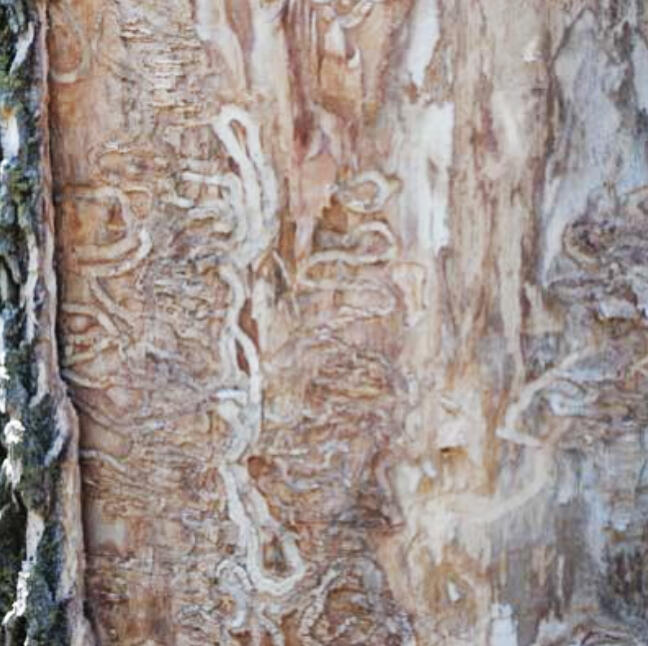
EAB larva making a gallery in ash tree. Photo: Pennsylvania Department of Conservation and Natural Resources - Forestry, Bugwood.org.
Are you and your family stuck inside because of the tremendous cold gripping Minnesota this weekend? It may be a rough few days, but for those who care about Minnesota’s forests, there’s a silver lining to this arctic blast: emerald ash borer (EAB) larvae may die in high numbers.
Research conducted here in Minnesota shows that when the air temperature reached -20°F, approximately 79% of EAB larvae died, and at -30°F, about 98% died.
Larvae are the life stage that overwinters in ash trees, and it’s important to know that snow can insulate tree bark and protect the EAB larvae burrowed below. However, this year’s deep freeze, combined with relatively low snow depths in much of the state, means EAB is likely dying on these cold days.
Some will survive
Sadly, this doesn’t mean Minnesota’s EAB problems are over. EAB populations won’t die off completely, but they will be reduced, thereby slowing their impact.
This can give homeowners and natural resource managers a little more time to treat, remove, pre-plant, and otherwise manage for the long-term impacts of EAB on ash trees and forests.
Stay warm, stay safe and take solace in the fact that EAB are being killed by these fatal temperatures, thus helping us continue to actively manage this deadly invasive species.
Learn more about emerald ash borer in Minnesota.
