


Emerald Ash Borer in Buffalo - What you need to know
City of Buffalo staff members Beth Opheim-Geographic Information System/Engineering Technician and Adam Farrell- Parks Superintendent shared some important information about Emerald Ash Borer (EAB), which was found in Buffalo in February this year.
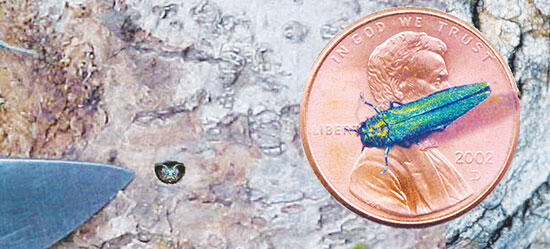
EAB is an invasive pest, small beetles that attacks all species of ash trees. “You can’t see that the tree is infected initially, it takes three to four years to see decay in a tree,” Farrell shared. This means the EAB they found near downtown Buffalo has been there for years.
Opheim shared some signs to watch for when it comes to EAB. Lightening of the bark, which is also called blonding is one sign of EAB. Other signs include: loss of tree canopy, increased woodpecker activity, and short branches at the trunk of the tree.
“We had been noticing signs of EAB in our bigger parks such as Sturges and West Pulaski. Although we have seen signs, we haven’t confirmed all of these yet,” Farrell stated. “We will be replacing the public trees with other species,” Opheim said.
The City was awarded with a grant to help fund the removal and replacement of the infected trees. Funding for this project was provided by the Minnesota Environment and Natural Resources Trust Fund as recommended by the Legislative-Citizen Commission on Minnesota Resources (LCCMR). This project was conducted in cooperation with the Minnesota Department of Natural Resources.
If you see a public tree in the city of Buffalo that appears to be infected with EAB, you can call Buffalo City Hall at: 763-682-1181.
If homeowners notice signs of EAB on trees on their property, Farrell and Opheim recommended speaking with a certified arborist to confirm that there is EAB and give guidance from there. Trees can be treated with insecticides for EAB or torn down if the damage is too severe. There is information on the City of Buffalo Parks Department website to help find an arborist: https://www.ci.buffalo.mn.us/158/Parks-Rec reation. Right now is the best time to tear down trees if needed, during the fall and winter months is ideal.
According to Farrell, if firewood is infected, it can still be burned or it can be brought to the City of Buffalo compost. Keeping firewood in the same spot can also help decrease the spread of EAB. The City of Buffalo compost is for Buffalo residents only. If you live outside the city of Buffalo, please contact your city hall.
For more information about EAB in Buffalo, visit: https://www.ci.buffalo.mn.us/158/Parks-Recreation.
