


Something to be proud of
In 1947, World War II veteran Raymond Weeks held an event in Birmingham, Alabama on Nov. 11. A parade and other festivities were organized, and the celebration was named “National Veterans Day” to honor all veterans who had served in the U.S. military. It was designated officially as Armistice Day, and later, U.S. Rep. Edward Ress, from Kansas, proposed a name change. In 1954, Congress passed this bill, and President Eisenhower signed it, proclaiming Nov. 11 as Veterans Day.
This annual, celebratory day is an opportunity to honor the U.S. military men and women who worked hard to protect and serve the country and its citizens. Parades are held, free meals are served, and American flags are seen flying high and proud.
For a longtime Buffalo resident, Doris DesMarais, the recognition and honor would have been seen as unnecessary, as she would rather have directed the spotlight to someone else she thought was more deserving. Though Doris recently passed, at the age of 98, her daughter, Laurie DesMarais, and family can take a look back in time through her war diary and newspaper clippings and get a glimpse of what her life looked like when she served in World War II.
Doris
Doris was born in Otsego Township in 1922 to Emil and Cecelia DeMars. As the third oldest of twelve children, Doris grew up in a busy household, always sharing some sort of adventure with one of her six sisters. Never having to be on her own, Doris was constantly connected with at least one of them, and it was that special bond that brought her to Miami, Florida during World War II.
Doris & LaVerna
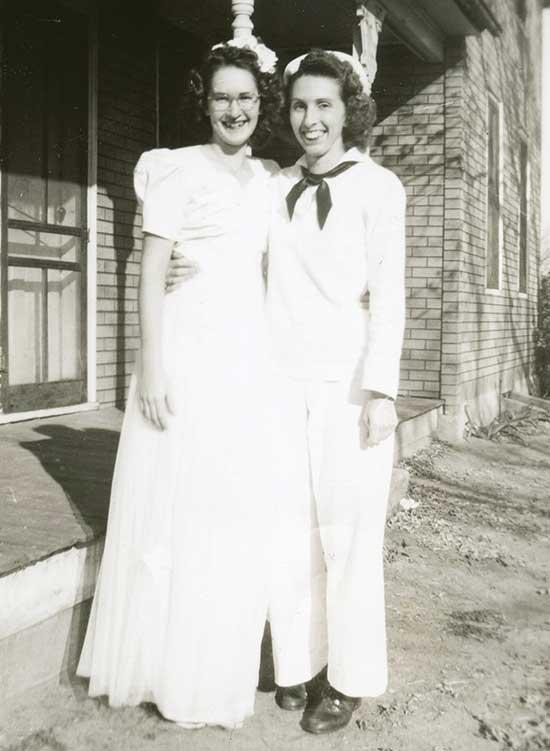
Doris and one of her sisters, LaVerna, enlisted in the U.S. Navy in August of 1944.
“Mama’s story as of why they went into the Navy was that there was a neighbor boy who was serious about Aunt Verna, but Aunt Verna wasn’t serious about him,” Laurie DeMarais said. “So, she said to Mama, ‘Let’s join the Navy!’ mainly to get away from him.”
The irony of the reason for enlisting, though, was LaVerna meeting her husband, Bud, on the beach in Miami, as her and Doris would enjoy most of their free time there, soaking up the sun and experiencing the ocean for the first time, being two young girls from Minnesota. LaVerna would soon be engaged and left the Navy in October of 1945, and eventually had 14 children.
New York
The beginning of Doris’s career with the Navy began with her sister in New York. After they enlisted, they traveled from Minnesota to the Sampson Naval Training Base; after WWII, the base was made into a museum. Women who enlisted were part of the Unites States Naval Reserve (Women’s Reserve) and were commonly known as WAVES (Women Accepted for Volunteer Emergency Service).
While at training, Doris and her sister had the opportunity to do some sightseeing and visited the Statue of Liberty.
“It was being remodeled or repaired, so they couldn’t go into the arm, but they got to go up to her head,” Laurie said of the memory her mother shared.
After New York, they headed to the naval air station in Miami and stayed at the WAVES Terrace Barracks, a big hotel-like building with patios and balconies where all of the WAVES stayed.
The Navy
Doris worked in an airplane hangar in what they called the “tool crib.”
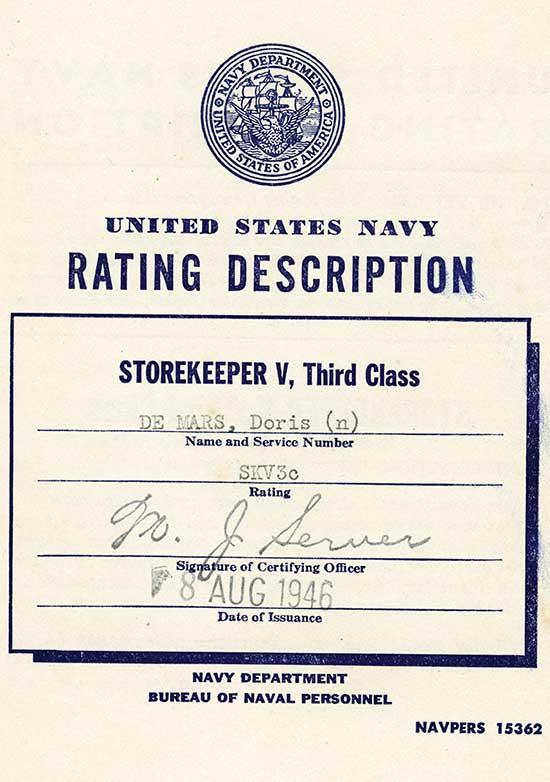
“Every time somebody needed something, to build airplanes, tanks, or whatever, they came to her,” Laurie said. “She’s the one who dispensed tools, bolts, or anything that was needed. She was called a Storekeeper.”
Doris would serve her two full years in the Navy and was honorably discharged in October of 1946. Her papers would identify her role as an Aviation Storekeeper, but when Laurie went to the V.A. to order her memorial stone, she learned some new information.
“They said she was a Seaman Third Class,” Laurie said. “They thought it was really something that her papers were handwritten, because they don’t handwrite much. It was a sign of the times.”
Regardless of her rank, Doris dutifully served her country. After being discharged, she still had paid leave left, so she was given $249.93 to compensate for that, and a travel allowance of $74.50 to get back to Minneapolis.
Coming Home
Heading home with a small booklet on how to return to civilian life, Doris enrolled in a 17-month program, the Veterans Vocational Training Course in Dressmaking and Power Sewing Machine. Programs like these were set up for returning vets to learn a skill or trade, with which they could find a job.
“My mama was never an office person,” Laurie said. “She made everything. She made a lot of my clothes, and being a Depression baby, she made little shorts sets that matched the kitchen curtains; she saved everything!”
Doris even got creative with her old uniform, sewing it into a skirt she could wear every day.
Doris married Lomer DesMarais on June 23, 1949 at the St. Albert’s Catholic Church in Albertville. She took on the role of housewife, letting her husband, a former Army soldier, take the “veteran” spotlight. Doris was a woman of few words but worked tirelessly behind the scenes to care for her family. She and Lomer would have two children, Laurie and Gary.
Reflecting on the Navy
While Doris and her husband would take a few trips here and there over the years, serving in the Navy was seen as her big adventure.
“Not a lot of women went in at that time,” Laurie said of her mother’s enlistment.
Most of Laurie’s information comes from looking through her mother’s “war diary,” in which she kept every little piece of mail, newspaper clippings, and postcards from her time in the military.
Doris kept in contact with three women she became close friends with after her sister left the Navy.
“They sent Christmas letters for years,” Laurie said. “One was from Wisconsin, and they would meet every once in a while.”
As someone who preferred to stay out of the spotlight, Doris was never big on the recognition of being a veteran.
“She always said that because she never left the States, that she wasn’t really a vet,” Laurie said. “She didn’t want the gun salute at her funeral. But reading about World War II, none of the women were allowed on the battleships, so there was no way she was leaving the States.”
Even though she did not talk much about her time with the Navy, Laurie is proud of how her mother served.
“I know she was glad she went in,” Laurie said. “I’d assume it was for the experience of it all. She stood back and let my dad be the veteran.”
Being a veteran, though, had a financial perk, as she never had to pay for medical bills.
“In 1951, she had to go to the V.A. Hospital in Minneapolis because she had a tumor,” Laurie shared. “They only had the big wards with beds all lined up, at the time, for men. There weren’t really any women vets coming there yet, so they cleaned out a broom closet for her, and she stayed there for about 14 days.”
Remembering Doris
Doris’s stayed in her home until she was 97 years old, when she then needed to live in a nursing home. In 2020, Park View Care Center helped her family celebrate her 98th birthday with her through the window and decorated for the special event, and Doris later passed away on Sept. 28, 2020.
Doris’s family respected and honored her time with the military at her funeral, with full military honors.
“She was there and served,” Laurie said. “It was something to be proud of.”
Looking back through her mother’s wartime memories and war diary, Laurie got a glimpse of a different side to her mother’s personality.
“Mama was a homebody,” Laurie said. “I wish I could have seen what she was like in Miami. It is very cool to look at all of the memories. She was the wind beneath us, taking a backseat, always, to help us.”
