

December garden checklist
UNIVERSITY OF MINNESOTA EXTENSION - www.extension.umn.edu
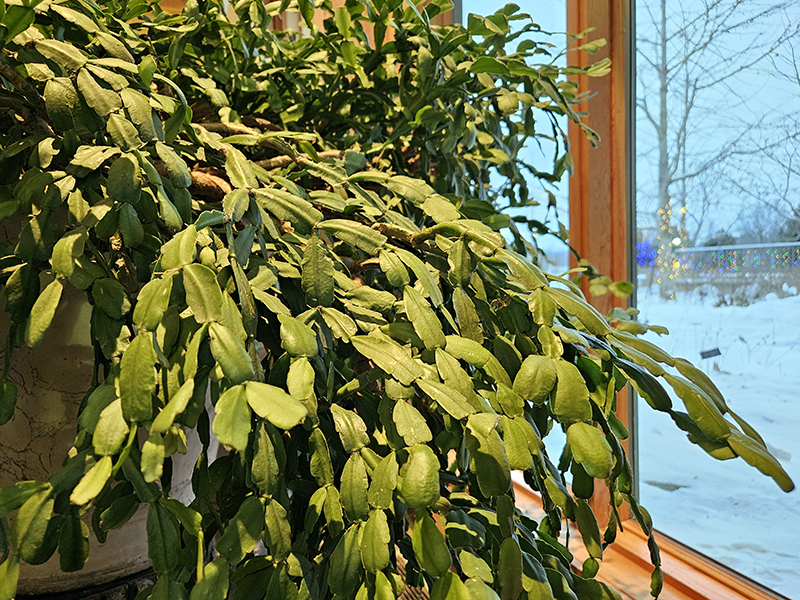
Mystery of the month
Why isn’t this holiday cactus blooming?
The solution is at the bottom of this article.
Pests and diseases
Read the instructions on any deicing salt containers before applying them to your driveways, sidewalks, and other hardscape areas. While deicing salts are not a pest or disease issue for plants, they can negatively impact our gardens when used improperly.
- Excessive salt build-up in the soil dries out plant roots.
- When the salt is dispersed during snow plowing or sprayed across evergreen leaves, the leaves can dry out, brown, and eventually fall off.
Learn more about the effects of deicing salts on landscapes in Minnesota.
Trees and shrubs
Look for signs of animal browsing on shrubs and young trees. If you see gnawed stems and do not want the critters to chew on the plant, add a hardware cloth fence to keep out small animals, such as rabbits and mice, or livestock fencing to keep deer away.
Before putting up any fencing, check for signs of a nest around the base of the plant — you do not want to accidentally cage animals around the plants.
Read more about protecting trees and shrubs in winter.
Flowers and other garden plants
Check any overwintering bulbs, like dahlia tubers and canna bulbs, for soft spots, mold, and dryness. Rotting typically occurs if:
- The bulbs were damaged when the plants were dug up in the fall.
- The storage temperature is too high.
- There is poor air circulation.
Remove all damaged plants and correct any environmental issues in the storage area before putting good bulbs back into storage.
Read more about caring for bulbs.
Houseplants
Clean houseplant leaves as part of your winter cleaning activities. Plants receive less sunlight during winter, particularly those that rely on the ambient light in a room. Dust build-up on leaves further decreases the amount of light plants receive.
Plain water and a soft cloth are all you need to clean your plants’ leaves. Make sure to switch the cloth if you notice insects or disease on a plant; you do not want to spread any issues to your other plants.
Learn about caring for houseplants.
Lawn
Even with the latest blanket of snow covering lawns, it isn’t too late to be thinking about dormant seeding. If there is a warm-up at any point this winter and the snow melts, consider spreading seed in areas you wish to improve.
Seed can be spread anytime between now and early spring to take advantage of this practice.
Check out Dormant seeding to establish or improve your lawn for more tips on dormant seeding.
Other tasks
Don’t fall for the advice to add sugar or sugary drinks to holiday tree water basins. The sugar can cause mold to form, which clogs the plant tissue that is responsible for moving water into the tree.
Plain water is all the tree needs. Just make sure the cut end of the stem is always under water.
Solution to the mystery of the month
The mystery photo is of an Easter cactus.
The first thing you need to do is identify the type of holiday cactus you have. There are three holiday cacti (Schlumbergeraspp.) that are commonly grown in Minnesota: Thanksgiving (S. truncata), Christmas (S. bridgesii), and Easter (S. gaertneri). They all bloom at different times of the year, depending on light levels and seasonal changes.
-
Thanksgiving and Christmas cacti bloom after at least 6 weeks of shorter days, which is why we typically see them bloom late in the year.
-
Easter cactus blooms 8 to 12 weeks after day length starts increasing, which is why they bloom in late winter to early spring.
So you may have an Easter cactus that isn’t blooming in December because it isn’t time yet.
Many other factors influence the flowering of holiday cacti. Learn more about the common issues section of holiday cacti.

Easter cactus stems have rounded edges.

Thanksgiving cactus have distinctive points on the stems.

Christmas cactus have shorter points on a wider stem than the Thanksgiving cactus.
