
Battling bacterial canker in tomatoes
UNIVERSITY OF MINNESOTA EXTENSION - www.extension.umn.edu
We have gotten a few reports of bacterial canker from high tunnel growers around Minnesota. Read on for tips for ID, management advice, and a chance to inform future research.
What is bacterial canker?
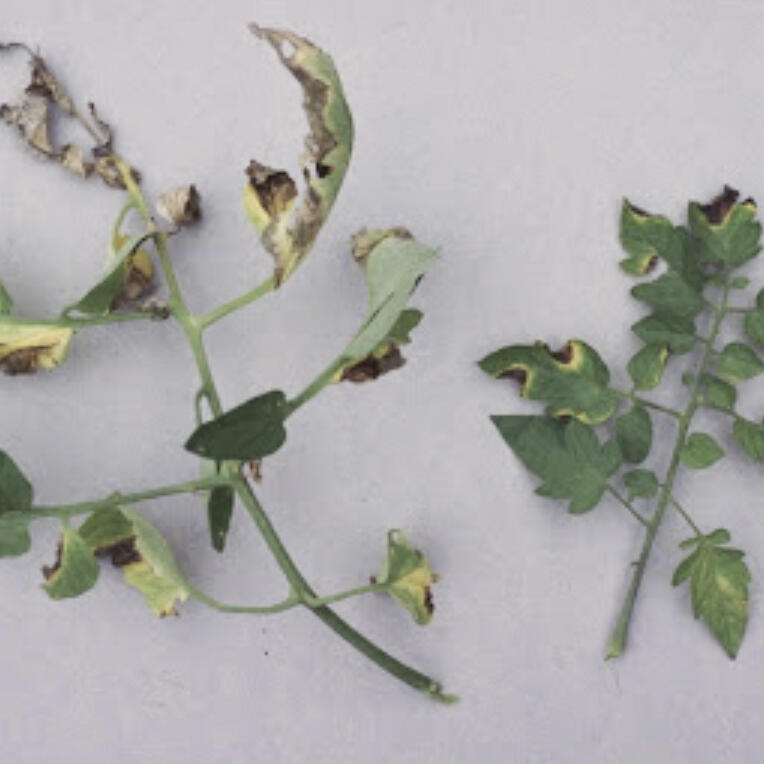
Bacterial canker, caused by the bacteria Clavibacter michiganensis, is a disease that can affect all parts of the tomato plant — from leaves to stems to fruits. It causes leaf edge yellowing and browning, discolored stem tissue, and spots on fruit. Symptoms are sometimes split down the middle of a leaflet or plant.
 |
| Leaf edge discoloration starts small but can progress and cause leaf death. Photo: Mary Ann Hansen, Virginia Polytechnic Institute and State University, Bugwood.org |
This is a disease to get confirmed by a lab — there are a couple of disease that can cause similar symptoms (including other diseases with long term management implications). If you still have suspect plants that are holding on, get a sample into the Plant Disease Clinic. If plants are already crispy and dead, diagnosis will be tricky — instead send in plants that are in the process of crashing out if any are available.
How does bacterial canker get onto farms?
This disease has a couple of routes onto the farm. It can move in on uncleaned tools, and is known to be seedborne. It can also come in on infected transplants, which may or may not show symptoms of the disease. You can learn more about the finer details in our article Tomato Transplants & Bacterial Disease.
 |
| The pathogen, Clavibacter michiganensis, moves through plant vascular tissue. This causes stems to be brown. Photo: Paul Bachi, University of Kentucky Research and Education Center, Bugwood.org. |
How does bacterial canker stay on farms?
Bacterial canker survives in plant residue and on surfaces. Surfaces include anything an infected plant touches at any point in its growth — from transplant trays to pruners to wooden stakes to twine.
 |
| Fruit spots are the most distinctive symptom, but don't always develop. Photo: Heinz USA, Bugwood.org. |
So, what can you do about bacterial canker?
There are tasks that can be done as this growing season wraps up. These include.
- Clean out as much of the plant material as you can. The pathogen will hang around as long as plant residue does. Don't put this material in a compost pile — burn it, trash it, or dispose of it outside of production areas.
- In field plantings, chop residue and incorporate it into the soil.
- Look at tools and surfaces plants touch, clean and sanitize them this winter. Think about things that are used during transplant production and the high tunnel season. Sanitation could be with steam or with a sanitizer.
Looking ahead to next season...
- Rotate tomatoes and peppers out of the high tunnel for 3-4 years, and in the intermediary time, make sure to take care of volunteer tomatoes and solanaceous weeds, like black nightshade.
- Be really attentive during transplant production — this time has a huge impact on how this disease spreads, and can be the most effective time to manage. If you are raising your own transplants, get new plastic flats, and clean & sanitize everything else.
- Set up plantings so that varieties are separated, with a chance to clean and sanitize hands and tools in between the blocks.
- Consider preventative pesticide applications. For convectional growers, Tanos can work. For organic growers, copper is probably the best bet, but even then performance isn't always great. There aren't a lot of products labelled for bacterial canker, and how they perform on the farm can vary a lot. See the Cornell resource below for a helpful summary. Check the label to make sure the product is allowed for greenhouse use.
Want to learn more about bacterial canker?
If you have bacterial canker or suspect you have bacterial canker, reach out. The University of Minnesota is developing research around this disease, and we want to make sure it reflects grower experiences and concerns. Reach out to Marissa (mschuh@umn.edu or 612.460.7462) if you are interested in informing our research.
Further Reading
- Bacterial canker of tomato, UMN Extension
- Organic Production and IPM Guide for Vegetables, Cornell University
