
American persimmon breeding could lead to a cold-hardy, multipurpose fruit crop for the Upper Midwest
UNIVERSITY OF MINNESOTA EXTENSION - www.extension.umn.edu
Kathleen Rhoades is a plant breeder who works for the Savanna Institute, a non-profit organization that focuses on sustainable food production systems. Their major emphasis is on agroforestry, which integrates trees and shrubs into crop and animal farming. Agroforestry can be the main focus of a farm, be combined with farm landscape needs such as windbreaks, and riparian buffers, or complement already-existing row cropping (alleycropping) or grazing settings (silvopasture)*.
The use of a crop that can be incorporated into one of these systems or settings can include its leaves (used for fodder), seeds, or fruits, while lumber can also be used in some cases. One example fruit tree in their program is the American Persimmon (Diospyros virginiana), which has received little attention from other research organizations in past decades. This is one of two crops that Kathleen Rhoades is working on in her breeding program, which aims to produce a number of cultivated varieties suitable for the Upper Midwest. I had the opportunity to talk with Kathleen to learn more about American persimmon, and the following are highlights from our conversation together.

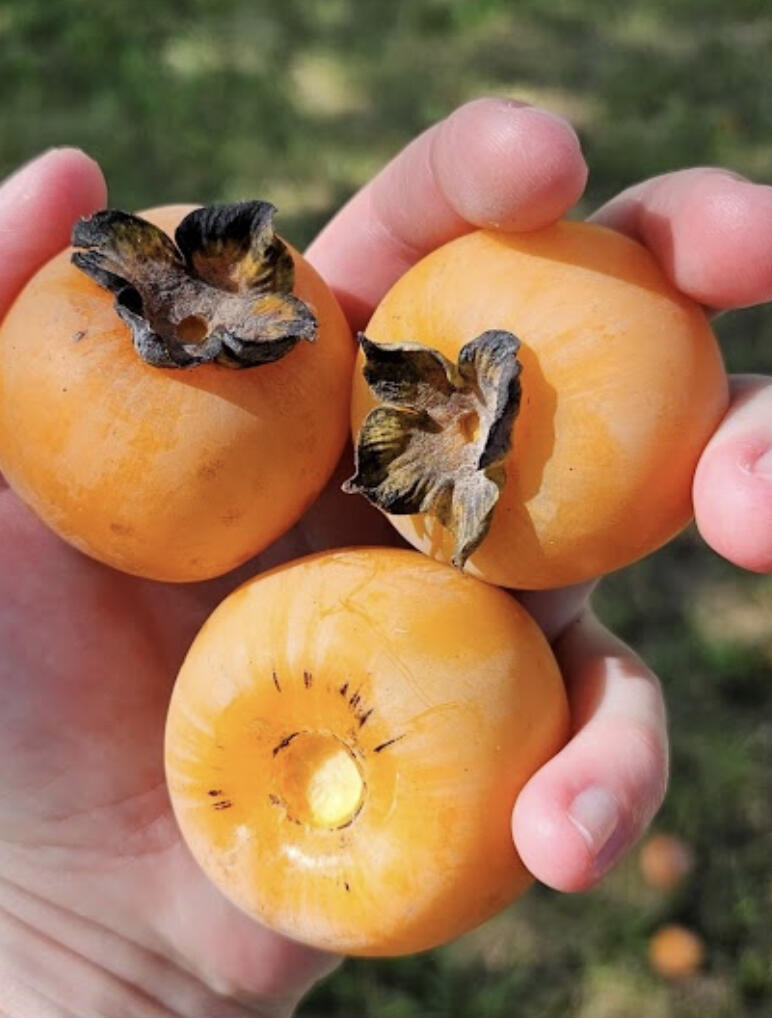
Image: A few American persimmon fruits fit into the palm of a hand. Photo from Kathleen Rhoades.
The American persimmon is a part of the genus Diospyros, which includes a number of species (most of which are tropical, or subtropical) including Asian persimmons, known commonly as kaki in Japan, date-plums, and black sapote, commonly found in Mexico and Central America. The American persimmon is uniquely found in North America with some germplasm showing signs of cold hardiness.
Historically, American persimmons were used by a number of communities for food before colonization, and later used for fermentation to make drinks like beer. The American persimmon exhibits some astringency, which decreases as the fruit ripens and is attributed to tannins. One of the most unique uses that Kathleen shared for Asian persimmon, for example, is its use to create a natural dye in Japan using green fruits that are fermented for a couple of years to create an orange color that develops over time.
American persimmons are similar to other fruit crops in that it takes a longer time to achieve breeding goals based on their life cycle and how long it takes for a tree to reach maturity and produce fruit. One advantage of modern crops, like apples, which have been at the forefront of fruit breeding in Minnesota and the U.S. is the number of rootstocks that can reduce how long it takes for a tree to produce fruit. American persimmons commonly take around seven years to start producing fruit and have a secondary challenge for their selection: they’re dioecious, which means that plants produce either male or female flowers on a single tree. This means that not all trees could produce fruit by the time they are mature. Dioecy can become even more complicated as some species can change their sex, and it’s not well-understood if American persimmon does this.
A major trait Kathleen is hoping to select for is cold hardiness, which is not universal among all American persimmon as many thrive in southern climates of the United States. The Savanna Institute recently completed a trial that planted out 60,000 seedlings on their research farm near Spring Green Wisconsin, a site that reaches low winter temperatures and high winds throughout the winter. The results were surprisingly positive as only around half of the seedlings died.
From this study, around 5,000 of the healthiest trees were selected from and transplanted out into a new orchard block. From here, there are a number of selection goals: large fruits, firmer fruits, low abscission, improved flavors, and lower astringency; but not all of these traits are needed for every use for American persimmon.

Image: Rows of American persimmon trees are grown and evaluated for traits like cold hardiness as a first step for their selection process. Photo from Kathleen Rhoades.
Kathleen discussed that fresh eating is something they want to obtain someday, but silvopasture and processing are more likely to come first. It’s been noted that American persimmons can be used to feed hogs and other animals, who tend to be less picky as they can consume fruits that fall to the ground and don’t mind eating the seeds. Fruits bred for processing can also have seed, as pulp extraction can be done before freezing and shipping the product to purchasers.
When it comes to fresh eating, however, flavor development, seed presence, and fruit firmness count. Kathleen mentioned that a fresh American persimmon can feel like holding a handful of pudding. It’s that soft in texture and composition, though the flavors still hold up to offering something unique for consumers.
While the future of when new cultivar releases will likely take a while, there’s a lot of work that generally is needed to support breeding with American persimmon that Kathleen is doing now. Her program now has a reference genome based on the variety Early Golden that she is using to make meaningful comparisons to other cultivars. She is also interested in exploring more projects related to persimmon rootstocks, which could benefit the Asian persimmon industry as well since most Asian persimmon scion is often grafted onto American persimmon rootstock.
As a fruit educator, it’s exciting to see the development of crops like American persimmon that can support a wide range of farming and a diverse number of settings. It gives a certain weight to the trajectory of options that can help build resiliency for the future, while keeping things flavorful and sweet.
*Many of these crops, like elderberries, currants, and honeyberries, can and are already being grown in a more conventional way of planting in rows with aisles in between.
Thank you to Kathleen Rhoades and the Savanna Institute for information and photos provided in this article.
