

Native Plant Month raises new questions in a changing climate
UNIVERSITY OF MINNESOTA EXTENSION - www.extension.umn.edu
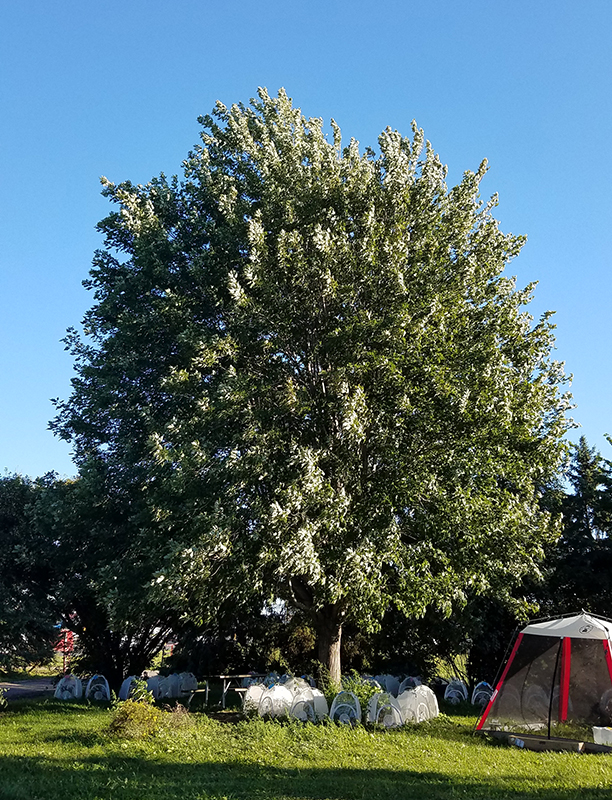
'Silver Queen' silver maple
April is Native Plant Month in the United States, giving us an opportunity to celebrate the plants that have evolved over thousands of years in our specific regions. These plants provide important habitat for local wildlife and are generally well-adapted to local conditions.
But climate change has sparked many interesting questions. What does “local” mean — is it your city, your state, the Upper Midwest, or the whole eastern United States?
As temperatures increase and precipitation becomes more erratic, should we rethink where native plants belong or could thrive?
As roads, farms and cities limit how plants naturally spread, should people play a role in helping them move?
Native plant communities are diverse
Scientists use the term “native plant community” to describe a group of plants that interact with each other and their environment with minimal impact from modern human activity or invasive species. However, defining these communities requires choosing a point in time as a baseline. While ecosystems have always changed, the speed and causes of change have varied across the millennia.
A recent peer-reviewed study in the journal Restoration Ecology compared silver maple (Acer saccharinum) plant communities across a wide range of plant hardiness zones in the eastern United States. There is a surprising diversity of plants within the various silver maple communities.
In warmer regions — such as Georgia, Alabama and the Carolinas — bald cypress trees (Taxodium distichum) and shrub meadow holly (Ilex decidua) are commonly found alongside silver maple.
In cooler regions, including northern Minnesota, silver maple communities include species such as bur oak (Quercus macrocarpa) and Canada mayflower (Maianthemum canadense).
Assisted migration can boost adaptation
The study suggested that plants with narrow plant hardiness zones may be good candidates for human-assisted movement outside their current range, a process known as assisted migration. Plants with broader ranges may benefit from assisted gene flow, in which species are moved between regions within their current range to boost climate adaptation. For example, folks in Minnesota might consider sourcing silver maples from areas farther south, like Iowa.
The study also recognizes that plant communities are likely to shift with climate change. That change is not necessarily negative; more diverse or shifting plant communities may be better able to adapt to future conditions. Because of this, the diversity of plants within these silver maple and other native plant communities is a cause for hope.
Scientists, woodland stewards, and anyone interested in native plants can help us better understand these plant community changes by reporting observations to Extension’s Climate-Ready Woodlands participatory science projects.
